

What is a beach car?
A beach car is, above all, a feeling.
The feeling of wind, sea air, and a steering wheel in your hands on an endless coastal road.
It’s an open, lightweight vehicle designed for short journeys by the water. Not for the motorway, not for dense urban driving. For the beach, islands, second homes, and the paths that run along the sea.
Since the 1960s, a handful of models have embodied this lifestyle so naturally that they’ve become icons. Here’s their story and what it says about today’s beach car.
Beach car: a definition
A beach car is an open vehicle, without an enclosed body, approved for road use.
It stands out through:
- An open or semi-open body: air, light and scenery are part of the experience
- A compact size: ideal for narrow coastal village streets and tight tracks
- Leisure use: short distances, low speeds, relaxed driving
- Ease of use: Kate is accessible from age 16 with a B1 licence in the L7e category
An open beach car is not a gimmick. It’s a way of life.
The Citroën Méhari: the French seaside icon
Launched in 1968, the Citroën Méhari was the first major French beach car.
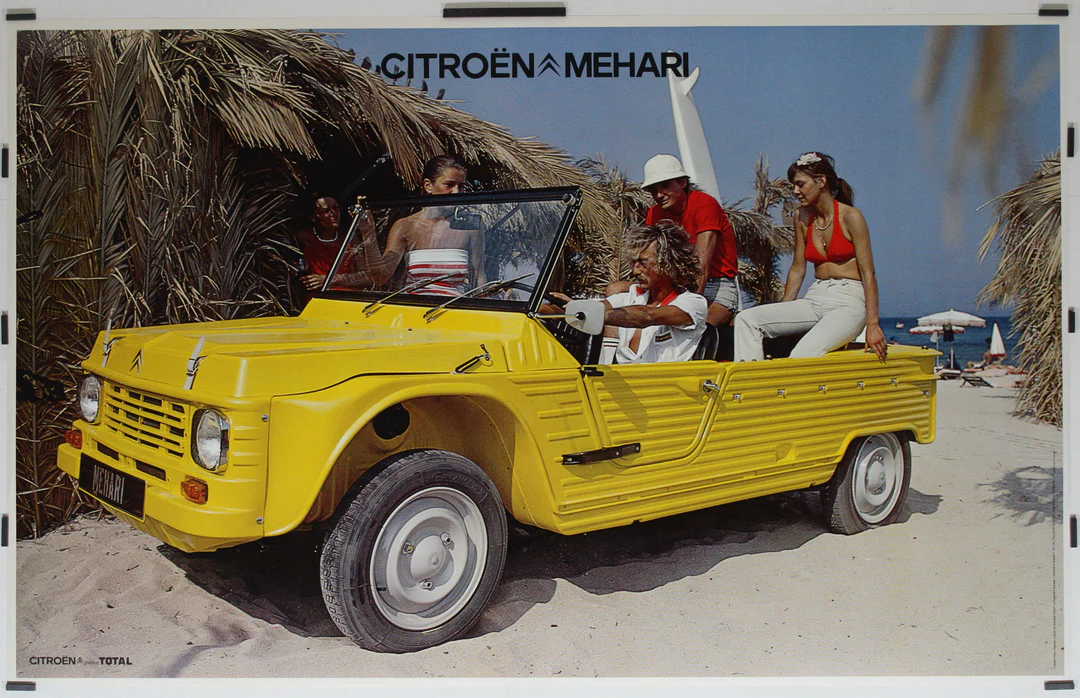
Its concept was simple: offer a lightweight, practical, open vehicle accessible to as many people as possible. Its ABS plastic body, light and colourful, gave it an instantly recognisable look. It quickly became a symbol of French summers, from the Atlantic coast to Mediterranean coves.
The Méhari appealed to surfers, families, the French army and even a few celebrities. It embodied a certain idea of coastal freedom: simple, relaxed and joyful.
Its limitations became apparent over time:
- ABS bodywork fades under UV exposure
- Untreated steel chassis prone to rust in salty environments
- Production ended in 1987
The Méhari remains an icon, but one whose intensive seaside use quickly reveals its fragility.
The Mini Moke: from military concept to global beach icon
Designed by Sir Alec Issigonis in the 1960s for the British armed forces, the Mini Moke never saw battlefield use. Its low ground clearance made it unsuitable for off-road conditions.

It found its true purpose on the beach. Lightweight, open and easy to drive, it quickly became the vehicle of seaside resorts around the world. From Saint-Tropez to the Caribbean, via Australia and Portugal, the petrol-powered Mini Moke became a symbol of 1960s and 70s glamour.

It appeared in films, on yachts, and in celebrity residences. Its minimalist design and boxy silhouette made it instantly recognisable, an iconic open car whose aesthetic still influences beach cars today.
Challenges in modern use:
- Ageing mechanics: corrosion, breakdowns, scarce parts
- No three-point seatbelts, no modern braking systems
- High restoration costs: between €10,000 and €30,000
- Internal combustion engine difficult to maintain
The Fiat 500 Jolly: the Italian luxury beach car
A contemporary of the previous two, the Fiat 500 Jolly represents another vision of the beach car: refinement and prestige.

Created for yacht owners and wealthy clientele on the Italian Riviera, the Jolly is a transformed Fiat 500: no roof, woven wicker seats, and colourful bodywork. It embodies La Dolce Vita, that Mediterranean lifestyle where elegance and lightness coexist naturally.
What these three icons have in common
Beyond their differences in style and origin, the Méhari, Mini Moke and Fiat 500 Jolly share the same fundamentals:
- An open body that connects the driver directly to the environment
- A compact size suited to coastal and island roads
- Leisure-focused use rooted in a seaside lifestyle
- A timeless design that transcends decades
What these vehicles have not resolved is durability. Corrosion, ageing engines, hard-to-find parts and rising maintenance costs, the petrol beach car remains beautiful but fragile.
Kate: the beach car for today
Kate builds on their legacy with today’s standards.
Kate is a beach car, hand-built in Cerizay (France), for over 10 years. Approved in the L7e category, 4 seats, electric, up to 235 km range (WMTC cycle), fully customisable.
→ Discover how Kate is built: full presentation of the manufacturing process

What Kate does differently
Durability
Cataphoresis is an anti-corrosion treatment used by premium car manufacturers. The body is immersed in a protective bath, including hollow sections. Kate maintains its standards season after season.
Maintenance
Electric by design, Kate requires no oil changes, timing belt or carburettor. Annual servicing focuses on essentials: brakes, tyres and auxiliary battery. For a vehicle used in a second home or on an island, this offers unmatched peace of mind.
Availability
Kate is an active manufacturer. Parts are available, after-sales service is accessible, and a network of partners exists across Europe. No uncertainty about the vehicle’s future.
What Kate shares with its predecessors: openness, lightness, and the pleasure of driving by the sea.
What it adds: reliability, durability and modern awareness.
Kate is present in more than 20 destinations across France and Europe. Discover our Kate Centers in Saint-Tropez, Cap Ferret, Ibiza and Saint-Barthélemy.
→ View all our Kate Centers
FAQ: Kate, the beach car
What exactly is a beach car?
A beach car is an open, lightweight vehicle designed for low-speed coastal journeys.
What is the difference between a beach car and a buggy?
Historically, a buggy refers to an off-road vehicle with oversized wheels. A beach car is an open vehicle designed for coastal roads, not for off-road driving. Kate is a beach car, not a buggy in the technical sense.
Can you still buy a new petrol Méhari?
No. The Méhari ceased production in 1987. Available models today are vintage, and maintenance is increasingly complex.
How much does a new beach car cost?
Kate is available from €32,800 incl. VAT, fully customisable.
Which beach car should you choose in 2026?
For a new, reliable and durable vehicle by the sea, Kate is currently the only French beach car that is newly manufactured and under warranty. It combines the style of 1960s icons with today’s technical standards.
Can Kate be used outside coastal areas?
Yes. Kate is designed for all leisure destinations: lakesides, vineyards, countryside, and even mountains off-season. Wherever life slows down and the landscape deserves to be enjoyed in the open air, Kate naturally fits.